Free Checklists Spot the Crack. They Don't Tell You if It Costs $50 or $20,000.
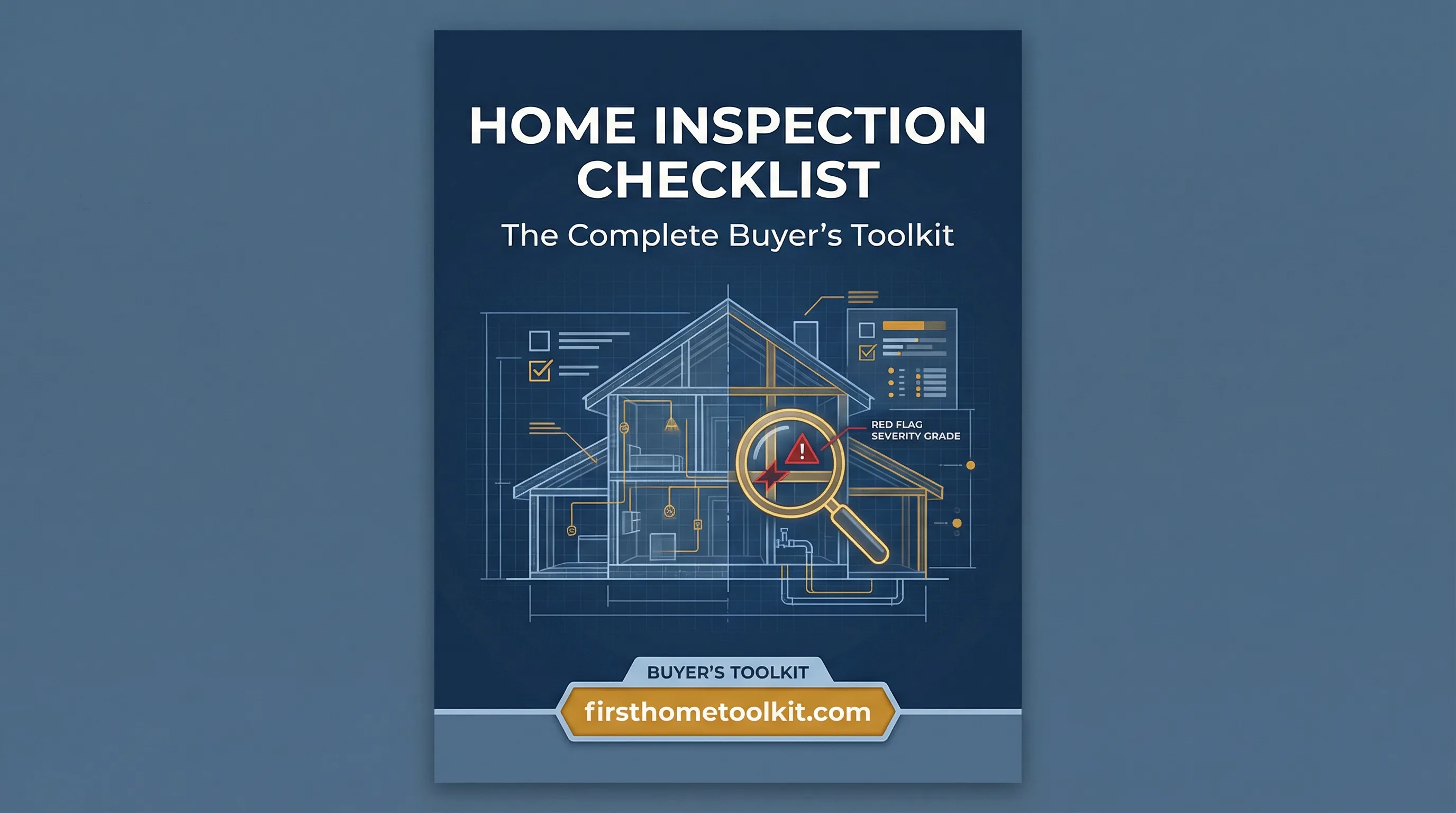
The Home Inspection Checklist is a Defect-to-Dollar System — a severity-graded, room-by-room inspection toolkit that doesn't just find problems, it translates them into money. Every finding is graded Green (cosmetic), Yellow (budget for repair), or Red (deal-breaker), with 2026-adjusted repair cost ranges attached so you walk into the negotiation with dollar amounts instead of anxiety. 150+ inspection points across structure, roof, electrical, plumbing, HVAC, and interior — plus a Data Plate Decode guide to read the exact age of any furnace or water heater from its serial number, negotiation scripts to turn findings into seller credits, and country-specific modules for the US, UK, Canada, Australia, and New Zealand.
Here's the problem nobody talks about: You walk through a house. You love the kitchen. The paint looks fresh. The floors shine. You make an offer. The $500 inspection comes back with 47 items, half of them in code language you don't understand. "Efflorescence on foundation wall." "Galvanized supply lines with reduced flow." "Double-tapped breaker." You have 72 hours to respond. You don't know which items are cosmetic and which ones will cost $15,000. And the free checklist from Zillow didn't prepare you for any of this — because Zillow makes money when the deal closes, not when you walk away from a money pit.
Covers the US, UK, Canada, Australia, and New Zealand — with country-specific terminology, hazards, and regulatory frameworks for each market.
Is This For You?
This guide is for you — the buyer who:
- Is about to spend $300,000–$800,000 on the biggest purchase of your life and wants to know what you're actually buying — not what the staging and fresh paint are designed to make you think you're buying
- Walked through a house and noticed a crack in the foundation but doesn't know if it's normal concrete shrinkage or a sign the wall is failing under soil pressure
- Got an inspection report full of technical jargon and has no idea which items to negotiate on and which ones to let go — or how to phrase the repair request without killing the deal
- Downloaded a free checklist and realized it's just a list of rooms with empty boxes — no severity ratings, no cost estimates, no guidance on what actually matters
- Is buying in a competitive market and needs to filter out money pits at the open house before spending $500 on a professional inspection for a house with obvious deal-breakers
- Wants to walk into the negotiation with actual dollar amounts — not vague feelings that the roof "looks old" — so their agent can request a specific credit backed by data
Free checklists are written by people who profit when you buy the house. This guide is written for the person who profits when you buy the right house.
What's Inside the Defect-to-Dollar System
The Showing Scan (1-Page Quick Check)
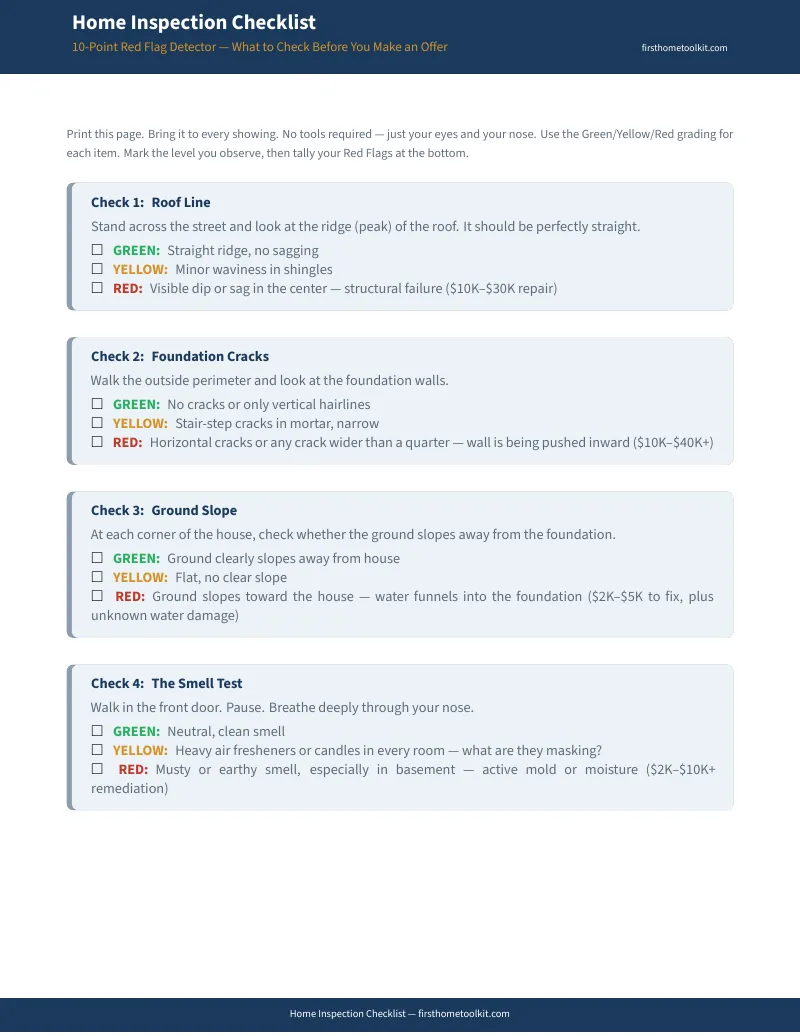
Professional inspections cost $400–$800 — you can't afford one for every house you view. This one-page triage tool lets you eliminate obvious money pits during the open house, before you fall in love with the kitchen and lose your objectivity. Five sensory checks in under 60 seconds: smell (mold/sewage/air freshener masking), sight (roof sag, foundation cracks, grading slope), and sound (traffic, HVAC cycling, plumbing). One check of the soil grading from the sidewalk can tell you more about the basement than the entire listing.
Room-by-Room Technical Inspection (150+ Points)
You get an inspection report with 47 findings and 72 hours to respond — but you can't tell which ones matter. This system grades every finding Green (cosmetic), Yellow (budget for repair), or Red (deal-breaker), so you instantly know whether a finding is a $50 fix you can ignore or a $15,000 emergency you need to negotiate. No more treating a loose cabinet hinge the same as a horizontal foundation crack.
The Data Plate Decode Guide
The seller renovated the kitchen and repainted the walls. They didn't replace the 22-year-old furnace behind them. This guide teaches you how to read the manufacturer's serial number on any furnace, water heater, AC condenser, or boiler to determine its exact age — because "the HVAC seems old" is a feeling, and "the furnace is 19 years old and past its statistical life expectancy" is a $5,000–$12,000 negotiation position.
Repair Cost Estimation Matrix
The average inspection uncovers $14,000 in needed repairs, but the average buyer negotiates less than $5,000 — a $9,000 gap that comes straight out of your pocket. This matrix gives you 2026-adjusted price ranges for every major system: roof replacement, furnace/AC, electrical panel upgrade, foundation repair, sewer line, re-piping, and more. Walk into the negotiation with data, not guesses.
Hazardous Panel Identification
Federal Pacific Stab-Lok panels have breakers that fail to trip during overload. Zinsco panels have bus bars that corrode and fuse shut. Both are documented fire hazards that insurance companies refuse to cover — but most free checklists just say "check the electrical panel" without telling you which ones to walk away from. This visual ID guide shows you exactly what to look for, because the panel brand alone can make a house uninsurable.
Pipe Material Decoder
Polybutylene piping (grey plastic, 1978–1995) ruptures from the inside out as chlorine degrades it — a full re-pipe runs $6,000–$15,000. Galvanized steel corrodes internally until the hot water slows to a trickle. Cast iron waste lines channel and collapse. This decoder teaches you to identify each material on sight, because the plumbing you can see in the basement tells you what you'll spend in the first year.
Post-Inspection Negotiation Playbook
Most buyers blow their negotiation by asking the seller to fix every item on the report — including cosmetic ones — which makes sellers dismiss the entire request. This playbook sorts findings into three tiers: Safety Demands (radon, gas leaks, hazardous panels — non-negotiable), Credit Requests (aged systems with documented replacement costs), and Walk-Aways (when the numbers don't work). Includes word-for-word email scripts with itemized findings and dollar amounts.
The Red Flag Triage Matrix
A one-page severity reference card for the findings that cause the most regret. Horizontal foundation crack = Critical. Stair-step brick crack = High. Vertical hairline crack = Low. Musty smell = High. Double-tapped breaker = Medium. Know instantly which findings warrant a structural engineer and which ones are normal settlement — without Googling each one while the clock runs on your response window.
Country-Specific Hazard Modules
US: Federal Pacific panels, sewer scope recommendations, radon prompts, termite mud tube identification. UK: damp diagnosis (rising vs. penetrating vs. condensation), subsidence crack analysis, Japanese Knotweed check, leasehold alerts, boiler age assessment. Canada: Kitec plumbing identification, condo status certificate questions, winterization checks, knob-and-tube wiring flags. Australia: termite indicators, building & pest report guidance, pre-auction triage. New Zealand: leaky building cladding, meth testing prompts, weathertightness assessment.
EV & Smart Home Readiness Check
A house without EV charging capability is a $1,000–$5,000 upgrade hiding in your future — and legacy checklists still check for telephone jacks instead. Panel capacity assessment (100A vs. 200A service), NEMA 14-50 outlet check, neutral wire identification for smart switches, and solar lease audit questions.
Why Not Just Use a Free Checklist?
Free checklists exist everywhere — Zillow publishes one, your bank emailed you one with your pre-approval letter, and Pinterest has thousands in pastel colors. Here's what they consistently get wrong:
- They're binary. Your risks aren't. A free checklist gives you "Foundation: ☐ Good ☐ Needs Repair." It doesn't tell you that a vertical hairline crack is normal concrete shrinkage, while a horizontal crack in the upper third of the wall means hydrostatic pressure is pushing the foundation inward — a repair that starts at $15,000. Every item gets the same empty checkbox, so a loose doorknob carries the same visual weight as a structural failure.
- They're designed by people who profit when you buy. Zillow and Redfin's checklists exist to facilitate transactions, not impede them. They systematically avoid "deal-killer" language because alarming the buyer hurts the sale — and the sale is how they get paid. They'll ask if "washer/dryer hookups are in good shape" without defining what "good shape" means or flagging that rubber supply hoses are an insurance concern.
- The $3–$5 Etsy templates are made by designers, not inspectors. They look beautiful and photograph well for the listing. Many are actually real estate agent marketing templates repurposed for consumers — complete with headshot placeholders and logo spots. They treat all defects as equal checkboxes because they don't know which ones are catastrophic.
- Professional standards are written for professionals. InterNACHI and ASHI provide Standards of Practice that define what inspectors must check — but they're liability documents, not buyer tools. When the report says the inspector is "not required to traverse the roof," that protects the inspector. It doesn't help you evaluate the roof yourself.
Free tools give you a list of things to check. The Defect-to-Dollar System tells you what each finding costs — and exactly how to negotiate it.
— Less Than the Cost of Missing One Defect
Professional inspectors identify defects. They don't negotiate for you. They don't tell you which findings justify a $10,000 credit and which ones to ignore. They don't decode the serial number on the furnace and calculate its remaining life. They hand you a 40-page report in code language and leave you with 72 hours to respond.
This guide bridges the gap between "what's wrong" and "what's it worth" — so you walk into the negotiation with dollar amounts, not anxiety.
Compare it to:
- A professional home inspection: $400–$800 (and they won't negotiate for you)
- A structural engineer consultation: $500–$800 (for a single issue)
- The free Zillow checklist: $0 — and it was designed by people who profit when you buy
- One missed sewer line failure: $5,000–$20,000
- One missed foundation issue: $10,000–$30,000
30-day money-back guarantee. If this guide doesn't help you spot defects or negotiate better, you pay nothing.
This guide is an educational resource for homebuyers conducting property evaluations. It is not a substitute for a licensed professional home inspection, structural engineering assessment, or legal advice. Always hire qualified professionals for formal inspections and verify current building codes and regulations in your jurisdiction.
Try our free Home Inspection Red Flag Scorer — check the defects found during your inspection and get an instant severity score and repair cost estimate.
Every showing without a system is another chance to fall in love with a money pit. Get the Defect-to-Dollar System now and walk into your next viewing with the same knowledge the inspector brings — at a fraction of their fee.