Your Biggest Purchase Deserves More Than a Google Search
You're about to spend $300,000 to $800,000 on a house. You've got 47 browser tabs open, contradictory advice from Reddit, a partner who wants different things, and an agent who earns commission whether you overpay or not.
And the tools everyone tells you to use? Government guides that define "earnest money" but don't tell you how to negotiate when the inspection finds a failing HVAC. Agent-provided checklists designed to keep you trusting, not questioning. Etsy printables made by graphic designers who've never been to a closing. None of them warn you that wire fraud costs homebuyers hundreds of millions a year, or that the 2024 NAR settlement completely changed how buyer agents get paid.
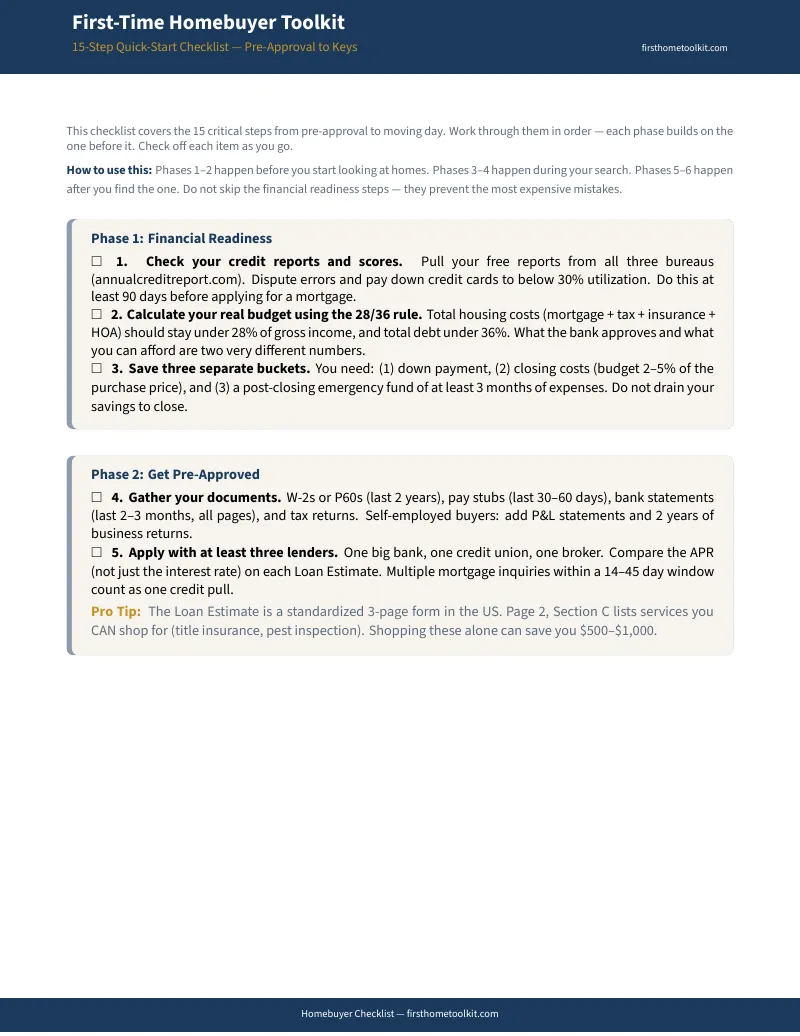
The First-Time Homebuyer Toolkit is a Deal Protection System — not a checklist to fill in after you've already made the decision, but a complete set of scorecards, calculators, scripts, and protocols that catches costly mistakes at every stage: before you tour your first home, during negotiations, at the closing table, and through your first 30 days as a homeowner.
Works for buyers in the US, UK, Canada, Australia, and New Zealand — with country-specific terminology, closing processes, and legal references for each.
What's Inside the Deal Protection System (9 PDFs + 1 Excel Spreadsheet)
The Complete Guide (73 pages)
8 chapters covering finances, team-building, house hunting, offers, inspections, closing costs, negotiation scripts, and move-in planning. Country-specific sections for US, UK, Canada, Australia, and New Zealand throughout. This is the spine of the system — read it once to understand the process, then use the standalone tools below in the field.
Property Comparison Scorecard (2 pages)
By house #6, you've forgotten what you liked about house #2. By house #9, you're exhausted and ready to offer on anything with a working kitchen. This scorecard uses weighted scoring — Unchangeables 50%, Expensive Fixes 30%, Cosmetics 20% — so you're comparing homes on what actually costs money (the roof age, the HVAC, the foundation grading) instead of what looks nice on a Sunday afternoon. Print one per viewing.
Agent Interview Scorecard (2 pages)
The 2024 NAR settlement changed how buyer agents get paid — and most buyers are signing representation agreements without understanding what they're agreeing to. This scorecard lets you rate 3 agents side-by-side with 10 word-for-word questions covering fee structure, commission negotiation, and what happens if the seller doesn't offer compensation. Know what you're signing before you sign it.
Lender Comparison Worksheet (2 pages)
Lenders quote "rates" but the rate isn't what you actually pay — the APR, origination fees, points, and terms are where the real cost hides. A 0.25% rate difference on a $350,000 mortgage is $16,000 over 30 years. This worksheet lines up 3 lenders on the numbers that actually matter, plus 10 questions to ask each one so you're comparing apples to apples.
Financial Readiness Worksheets (3 pages)
Your lender's affordability calculator tells you what the bank will lend. It doesn't tell you what you can actually afford. It leaves out property taxes, homeowner's insurance, HOA fees, maintenance reserves, and the $3,000–$8,000 you'll spend in the first 30 days on locks, blinds, appliances, and the things nobody warns you about. These worksheets calculate your true monthly cost based on your real life — including student loans, childcare, and the spending you're not willing to give up.
Wire Fraud Prevention Card (1 page)
Hackers intercept emails between buyers and title companies, then send spoofed wiring instructions days before closing. If you follow them, your entire down payment is gone — and it's almost never recoverable. This card has a STOP-CALL-VERIFY protocol with fill-in fields for verified phone numbers. Print it, tape it to your monitor, and use it before you wire a cent.
Final Walkthrough Checklist (2 pages)
The pre-closing walkthrough is your last chance to catch problems before you own them. Most buyers rush through it because they're excited and exhausted. This room-by-room checklist covers every outlet, faucet, appliance, window, and door — plus things that are easy to miss: verifying agreed-upon repairs were actually completed, testing the garage door, running the dishwasher, and confirming nothing was removed that was supposed to stay.
Needs vs. Wants Alignment Worksheet (1 page)
One of you wants a short commute. The other wants a bigger yard. Buying a home is a relationship stress test, and the arguments usually start at someone else's open house — the worst time to discover you have different priorities. Each partner fills this in separately, then you compare. It surfaces disagreements before they become expensive compromises.
Excel Financial Calculator
Auto-calculating spreadsheet for income, expenses, DTI ratio, and savings gap. Plug in your numbers and see your real budget instantly — including the costs your lender's calculator leaves out. Works in Excel, Google Sheets, and Numbers.
Who This Is For
This toolkit is for first-time buyers who:
- Feel overwhelmed by the process and want one clear path from pre-approval to closing day
- Want to compare homes objectively instead of relying on gut feelings and blurry photos
- Don't fully trust that their agent is looking out for their best interest
- Are buying as a couple and need a way to align on priorities before the arguments start
- Want to know the real costs — not just the listing price, but closing costs, immediate repairs, and the things nobody warns you about
After Using This Toolkit, You'll Be Able To
- Compare homes on what actually costs money — foundation, roof, HVAC — instead of gut feelings and blurry listing photos
- Interview buyer's agents with confidence, knowing exactly what to ask about fees and the new commission rules
- Protect your down payment from wire fraud with a 60-second verification protocol
- Calculate your true monthly cost of ownership — including the expenses your lender's calculator leaves out
- Negotiate inspection findings with specific scripts instead of panic
- Walk into closing knowing what every line on the Closing Disclosure means
- Move in with a prioritized list so you're not discovering at 11pm that you forgot blinds
Why Not Free Resources?
Free checklists exist. Government guides exist. Your agent will hand you a PDF. Here's what they actually give you:
- Government guides (HUD, CFPB) explain regulations but don't give you tactics. They define "earnest money" but don't tell you how to negotiate when the inspection finds a failing HVAC. They walk through the Closing Disclosure but don't show you where errors typically hide. They're textbooks, not field guides.
- Agent guides are sales collateral designed to keep you trusting, not questioning. They won't include an "Agent Interview Script" — because the whole point is to stop you from interviewing other agents. They gloss over the fact that you can negotiate commissions and fire an underperforming agent.
- Etsy printables ($3–$7) are designed by graphic designers, not real estate researchers. They look beautiful, but "Address, Price, Bedrooms" doesn't help you check the grading around the foundation, look up the electrical panel brand, or test water pressure in the upstairs bathroom.
- NerdWallet and Bankrate have useful mortgage calculators — but their business model is affiliate commissions from lenders. Their content is designed to get you to click "Apply Now," not to help you compare three lenders on the fees that actually affect your total cost over 30 years.
- Reddit has genuinely useful advice buried in chaos. One person says "never waive inspection," another says "you have to or you'll never win." You can't distinguish sound advice from survivor bias without a framework to evaluate it.
This toolkit combines all of them — the rigor of government data, the street smarts of buyer communities, the usability of a printable planner — into one Deal Protection System you can hold in your hand at an open house.
No affiliate links. No agent referrals. No mortgage product ads. Just the tools you need to buy a home without getting blindsided.
— Less Than a Single Hour of Your Agent's Time
Your agent manages 15 clients. You are one of them. This toolkit ensures you are tracking your deal, so nothing falls through the cracks when they get busy.
If this toolkit catches one issue — a $500 plumbing problem, a $2,000 closing cost error, or a fraudulent wire instruction — it pays for itself before you've finished the first chapter.
30-day money-back guarantee. If this doesn't make your home buying process clearer, you pay nothing.
Try our free Home Affordability Calculator — find out how much house you can actually afford based on your income, debts, and savings.
Close the 47 tabs. Open the toolkit. Start with the Financial Readiness Worksheet tonight.